


 On this site, we have an extensive library of articles covering just about every type of multiple bet there is. That includes the most simple accumulators of them all, doubles and trebles, as well as more complex wagers like the Super Heinz, the Lucky 63 and the Goliath (as well as many more). Here though we are swimming very much towards the shallow end of things and will take a closer look at the 4 fold (you may also see this written as fourfold, 4-fold, four-fold or four fold, and we will use these terms interchangeably). We will explain what a fourfold is, what you can place it on, how it works and other related options.
What Is a Fourfold Bet?
 A 4 fold is, quite simply, an accumulator, or acca, with four separate legs. In the order of accas, we have a double, a treble, then the 4 fold, the 5 fold and so on. Because much of the information about this is already covered in our piece on doubles (and many of the other articles we have mentioned), we will keep this 4 fold feature relatively short and you can refer back to those others for more thorough information.
So, a fourfold is simply an acca with four legs, a common bet being, for example, to bet on four of the Premier League’s top sides all to win. An example of such a fourfold might be:
- Man City to win at 4/7
- Liverpool to win at 4/5
- Chelsea to win at 10/11
- Man United to win at 7/10
As with any acca, there is one stake for the entire bet and all of the legs must win for you to see any return. So if, for example, the first three sides win 4-0 but Man United only draw, you lose your stake. On the other hand, if all four win 1-0 thanks to stoppage time penalties, you win the entire bet.
What Can I Include in a 4 Fold?
You can add more or less any selection you want into your 4 fold acca. That means you can use virtually any market, in any sport, at any odds and you can pick bets from the same sport or a range of different ones and the same applies to the markets you use.
In general, many punters tend to create an acca from the same sport, as in the case of our Premier League bet detailed above, or perhaps a fourfold covering four consecutive horse races at a particular track. However, if you want, you could make your own weekend fourfold acca covering a range of sports you intended to watch. You might start with the big Saturday race and the evening kick off, then follow that up with Six Nations rugby clash and some F1 on the Sunday.
What’s more, as said, you can use any markets, so you back the favourite to win the horse race, bet on over 2.5 goals in the football, place a first tryscorer wager on the rugby and finish things off with a driver to score the fastest lap in the Grand Prix. In short, your 4 fold can include more or less any bets you want, the only exception being that they must not be related.
Related Contingencies
When two markets are related in terms of their outcome or the chances of them happening, they are said, in bookmaker parlance, to be related contingencies. We look at this in more detail in the doubles article but it is often the case that markets on the same game or match, or involving the same player, cannot be combined into an acca.
One recent example of a related contingency that was accepted in error by a bookie and then not paid, under their palpable error clause (that legitimately allows them not to pay when a clear and obvious mistake has been made), concerned Emma Radacanu’s amazing US Open success. The punter placed what he believed was a £50 double on Radacanu. The two legs were for the Brit to beat her next opponent, Belinda Bancic, at odds of 6/5 and also to win the tournament at 15/2 and Carl Wright, who made the bet, believed he would be collecting £935.
However, this was not a valid double because if Radacanu was to win the tournament, she would clearly have to had beaten Bancic. The 15/2 for her to win outright effectively already included and accounted for the 6/5 for the individual match and, as such, these legs did not form a legitimate double.
If you place your bets online you will normally find that a bookie’s website will not allow you to add such related selections into your fourfold. Should you add related contingencies to a virtual slip, such as a side to win a football match and one of their players to score first, you will normally get an error message. To further clarify the concept of related contingencies, this is not permissible because the chances of both happening are related: if a side wins, it is more likely one of their players will score first and equally if one of their players scores first, they are more likely to be victorious in the game. For this reason, such a bet is a single with odds of its own (a scorecast), calculated separately.
Returning to the point at hand, should you attempt to place a bet like this online you should be prevented from doing so, possibly with a message stating “Selections cannot be combined” or words to that effect. Alternatively, the automated betting slip will just not offer the double, or any other acca. However, in general, any selections that can be combined into a fourfold (or other acca), will automatically be offered as such on the online slip.
Calculating Winnings

With any acca, winnings are calculated the same way and they accumulate from one leg to the next, hence the name of the wager. To keep things simple, let us imagine the fourfold acca below:
- Liverpool to beat Spurs at evens
- Everton to beat Norwich at evens
- West Ham to beat Burnley at evens
- Man City to beat Man United at evens
- Stake – £10
We can view the starting point for this bet as a £10 wager on Liverpool. If that bet wins at evens you win £10, which is added to the initial stake, and you then have £20 at evens on Everton. The Toffees win, meaning you win £20 and have £40 on the next game and so on. As such, if all four legs win, your total return is £160 for a net win of £150. Working out your winnings is easy enough but there are many online tools that make calculating your returns from a 4 fold, or any acca, a real doddle. In addition, with a straightforward accumulator like a 4-fold, which is all or nothing, your online betting slip will also show you your potential winnings when you make the bet.
Last but not least, it is also worth noting that calculating your winnings is also very easy if you have placed the bets using decimal odds, or even just understand how this pricing format works. In decimal odds, evens is 2.0, and to work out the overall odds (and thus potential return) for an acca, you simply multiply the odds of each selection. Thus, our 4 fold above is (2x2x2x2) 16 in decimal odds, or 15/1 as fractional odds, quickly showing that you stand to make a net win of £150 if all four legs win.
Each Way 4 Folds
As we have seen, you can make fourfold bets in virtually anything and you can also place them as win bets, or as each way. Each way fourfolds are most likely to be made on horse racing, though you can place them on any sport where each way betting is offered. An example of a non-racing 4 fold might be making an ante post (yes, 4 folds can be ante post too) bet on the top goalscorer in the Premier League, La Liga, Serie A and the Bundesliga.
The main thing to note with an each way fourfold is that, as with any each way accumulator, it is the entire bet that is each way. You cannot pick just some of the legs to be each way, the entire wager must be. So as with any each way bet, you have two bets really, in this case a win fourfold and a place fourfold and the two are independent of each other.
To land both bets, all selections must win. If one selection fails to place, all bets lose. If all four legs place, or some place and some win, then the each way part of the bet wins. Once again, this is something we explain in more detail in our article on doubles betting.
4 Folds from More Selections
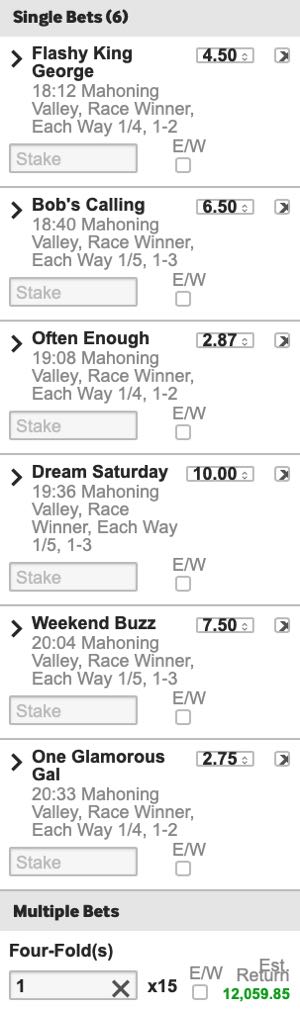 Aside from each way betting, there is another interesting option when it comes to fourfolds and that is placing multiple fourfold bets using more than four selections. This is a fairly simple concept that can be applied to all sorts of accas, no matter how many selections you want to include. The standard 4 folds we have looked at so far have involved picking four bets and combining them all. With such a get, you need to get all of your picks right.
However, you can also do fourfolds from five selections, six selections or even more. With a bet like this, you choose five or six horses, matches or whatever you are betting on and cover all the possible fourfolds that can be made from them. This way, rather than needing to get four out of four to see any return, you only need to get four out of five (or six, or however many selections you opt for). An example of such a bet might be as follows, using the anytime goalscorer market:
- Mo Salah to score
- Richarlison to score
- Cristiano Ronaldo to score
- Phil Foden to score
- Patrick Bamford to score
- Romelu Lukaku to score
This type of bet is known as a “fourfolds from six selections” wager. Using those six predictions you back all possible 4 fold combinations. So, for example, based on the numbered bets above, your first fourfold would be 1, 2, 3 and 4, meaning you need Salah, Richarlison, Ronaldo and Foden to score to win. Your next included acca would be 1, 2, 3 and 5, then 1, 2, 3 and 6, and so on until all possible accas involving four goalscorers were covered.
Such a bet would actually entail 15 separate bets to cover all the available options. This means that if you wanted to place £5 on each of the various fourfolds, it would cost you £75 in total. If just four of your predictions were right you would only land one of the 15 bets. You would need six to be right to win all 15 and, of course, if only three (or fewer) of your selected scorers found the back of the net then you would lose all 15 wagers and the full £75.
Whether you got four, five or six winning picks, your returns would depend on the precise odds of the selections within each winning 4 fold. As such, the betting slip cannot show you your potential returns, other than for a wager where you called all six scorers correctly and won all 15 of your bets.
Bets such as these are a good option when you want a bit more flexibility and margin for error. Of course, getting four out of six bets over the line is no easy feat in itself but it is certainly a lot easier than getting four out of four. Of course, you are paying for this insurance because each 4 fold covered by your wager requires a stake. Depending on the odds you will usually need to get five or six correct to make a really big net win, although as we have seen, at odds of evens just one winning fourfold delivers a combined price of 15/1.
And, of course, if you include some longer odds options, perhaps with a horse racing “four from six” bet, those winnings can soon add up, even if only one of your 15 4-folds is ultimately a winner. For example, with horses priced at 2/1, evens, 6/1 and 4/1, a £5 per bet wager costing £75 in total would return a massive £1,050 if they all come in!

